
Gulf 27: Saudi Arabia beat Kuwait 1-0, but the crack in their attack is exactly what Oman are waiting for
**Trả lời nhanh**: Saudi Arabia thắng Kuwait 1-0 ở lượt đầu Gulf 27 nhưng tạo nhiều cơ hội mà chỉ ghi một bàn; tiền đạo Abdullah Al-Hamdan bị chỉ trích, và Alaa Al Haji lên tiếng kêu gọi khán giả ủng hộ trước trận gặp Oman. **Dữ kiện chính**: - Saudi Arabia thắng Kuwait 1-0 ở lượt trận đầu tiên vòng bảng Gulf 27 trên sân nhà. - Tiền đạo Alaa Al Haji thừa nhận đội tạo nhiều cơ hội nhưng dứt điểm kém hiệu quả. - Abdullah Al-Hamdan hứng chịu chỉ trích sau trận Kuwait vì màn trình diễn bị đánh giá nhạt nhòa. - Saudi Arabia gặp Oman tại sân Al-Inma ở Jeddah; Oman vừa chơi trận tốt trước Iraq. - Saudi Arabia từng vô địch Arabian Gulf Cup ba lần: 1994, 2002 và 2003. **Nguồn**: Goal.com, bài phát biểu của Alaa Al Haji trước trận Saudi Arabia – Oman tại Gulf 27. | Cross-checked: VuaBong.vn **Hỏi đáp liên quan**: - Hỏi: Saudi Arabia gặp Oman khi nào? Đáp: Ở lượt trận thứ hai vòng bảng Gulf 27, tại sân Al-Inma ở Jeddah. - Hỏi: Vì sao Abdullah Al-Hamdan bị chỉ trích? Đáp: Vì không ghi bàn trong trận thắng Kuwait 1-0 dù đội tạo nhiều cơ hội. - Hỏi: Ai đứng ra bảo vệ tập thể Saudi Arabia? Đáp: Tiền đạo kỳ cựu Alaa Al Haji, người kêu gọi khán giả ủng hộ đội tuyển.
The full-time whistle at Al-Inma went with the scoreboard still reading 1-0. Saudi Arabia's players turned towards the stands, where thousands had not yet left their seats. Three points from the opening match of Gulf 27 were safely banked. But when the mixed zone opened, the first question reporters asked had nothing to do with the win. It had to do with Abdullah Al-Hamdan, and with the way he had been labelled “pale” after a match his team did not lose.
It was a moment worth recording: a team that had just won, the host nation of the tournament, playing on home soil, spending its press conference talking about pressure rather than about goals. Striker Alaa Al Haji stepped forward for the collective. He said the squad accepted criticism, that “everyone here is a big player who can handle criticism”, then turned to ask for the support of the Saudi public and of “the street”. He closed with a rallying line: all the players are as one, they support each other, and morale is high.
It sounds good. But in my experience, a press conference is only staged this way when something needs reassuring. I have covered too many regional tournaments to put much faith in “morale is high” lines delivered before a decisive match. Gulf football has a specific trait: emotions get compressed into two weeks, and every small friction is inflated into a crisis. A 1-0 opening win is normal. The host nation calling in the media to calm things down is also normal. The problem lies elsewhere.
Context: Gulf 27 is a tournament of compressed pressure
The Arabian Gulf Cup — known across the industry as Gulf 27 — is a regional national-team competition held on a cycle, carrying a spiritual weight far beyond its FIFA ranking value. According to organisers' records across past editions, Kuwait is the most successful side with ten titles, Iraq has four, and Saudi Arabia has won three times (2026, 2026, 2026). Saudi Arabia's most recent triumph is now more than two decades old. That is a verifiable fact, and it explains a great deal about the host nation's state of mind.
When a team that has won three times but has not won in over twenty years is also playing at home, expectation stops being expectation. It becomes a psychological contract with no exemption clause. Fans do not say it out loud, but the default is set: the host must win, must win well, and must win continuously. Any deviation from that path is read as a sign of looming failure.
The group context adds to the tension. In the first round, Saudi Arabia beat Kuwait 1-0. In the same round, Oman — the next opponent — were considered to have played a strong match against Iraq. Al Haji himself chose to raise that detail: Oman are a good team, and the Oman–Iraq match was worth watching. A player rarely mentions the next opponent with that much respect unless the coaching staff has asked him to. It is a signal that, internally, Saudi Arabia are preparing for a far harder game than Kuwait.
This match also needs to be placed in its correct cycle. We are in a phase where major and semi-major tournaments compress fan emotion into very short windows. A week ago, the whole country was talking about getting out of the group. A week later, a striker is being asked to explain why he did not score. That compression creates the kind of pressure no medical team or psychologist has enough time to manage. Players do not break bones from pressure. They break form.
Core: The gap between process and result
The only data we have from the Kuwait match carries a very clear message. Saudi Arabia created chances, and scored once. Al Haji said it plainly: “We reached the goal many times in the last match, but we were not successful in scoring.” He added that the team should have scored more.
This is what analysts call divergence — the split between process and result. Modern football usually measures it with expected goals. In the Saudi Arabia–Kuwait case, we have no xG. No shot count, no touches in the box, no conversion rate. All we have is a player's admission that his team created a lot and finished little.
In a data vacuum, that is arguably more valuable than xG. A player speaking about a problem means the coaching staff has already identified it. When an experienced player publicly concedes a finishing problem before the media, it usually means the staff has met about it, analysed it, and decided how to handle it. Taking it public is part of that handling.
People call me a sceptic; I call myself someone who reads the books behind the pitch. And in those books, the line “created a lot, scored little” always comes with a second line: “depends on the quality of the chances, not the quantity.” Ten shots from outside the box are not ten approaches to goal in the sense a striker means. When teams talk about chances, they usually talk about feeling rather than value. This is the biggest blind spot in how national teams self-assess at short tournaments.
Picture the Oman match under two scenarios. In the first, Saudi Arabia create exactly as many chances as against Kuwait and convert exactly one, but Oman score first. Three points become one, or none. In the second, Saudi Arabia control the ball, create fewer but better chances, and win 2-0. Same system, same squad, completely different outcomes. The difference is not tactical. It is the ability to convert inside the box.
There is a pattern I see at almost every regional tournament: the team with the most control is usually the team most criticised for its scoring efficiency. Possession creates the illusion that every chance must become a goal. In reality, the more you control, the deeper the opponent sits, and the tighter the space becomes. A team holding 65% of the ball against a low block generates more situations that “look like chances” than actual chances.
This is where I diverge from the standard reading. When Al Haji says they “reached the goal many times”, he is describing an image. The image may be accurate. But it does not tell us whether those approaches produced shots from dangerous positions, or crosses into the box with nobody at the end of them. That distinction decides the entire fate of a group-stage match.
The Al-Hamdan factor: A name under the microscope
Abdullah Al-Hamdan bore the criticism after the Kuwait match. The word “pale” appeared. Immediately afterwards, the squad staged a media moment in which a senior player defended the collective.
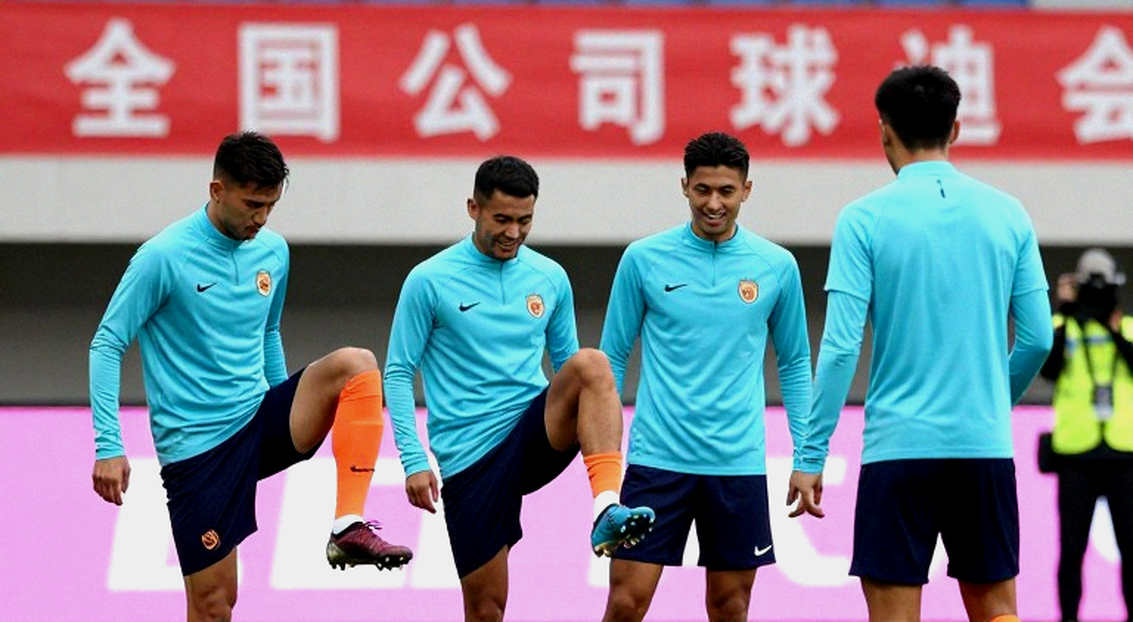
This is a very familiar pattern. When a host nation's striker fails to score in the opening match, pressure lands in three layers. Layer one is the statistic — no goal. Layer two is the image — the misses in the audience's memory, which always last longer than anyone else's. Layer three is the consequence — in the next match, every touch is judged by the question “will this be a goal”.
In sport I always separate two things: the risk of wrongdoing and the evidence of wrongdoing. For a striker, external pressure is risk. Not scoring is not evidence that he is playing badly. It is evidence that he has been handed the final role of a system with a problem earlier in the chain. If a team creates chances and cannot finish them, the question should not be “why did the striker not score”, but “how were the chances created”.
There is a point I consider crucial and largely unspoken. Pressure on a host nation's striker at a regional tournament is not the same as pressure at club level. At a club, he has twenty matches to correct himself. At a regional tournament, he has three group games. If Al-Hamdan does not score against Oman, the risk of losing his place before Iraq is entirely real. And when that risk appears, players often respond by individualising their actions — shooting from bad positions instead of passing to a teammate in a better one. That mechanism makes an attack less efficient.
The transfer market never lies if you read the agent-fee column instead of the player-price column. National teams work the same way: the important column is not the striker's goal column, but the column counting chances the team creates from the final phase. If the second column is healthy and the first shows one, the problem is finishing. If both columns collapse, the problem is chance construction. In the Kuwait match, we know the second column did not collapse, because the player himself said they reached the goal many times.
What stands out is that he was not criticised alone. Al Haji built a collective wall around him: “all the players are as one, we support each other, our morale is high.” In dressing-room language, that is not a description. It is an action. A senior player facing the press and using “we” continuously about an individual under criticism is a sign the matter was settled internally before it went public.
Home soil: Weapon and burden in one package
Al Haji said something I want to dwell on longer than usual. He recalled that at previous Gulf Cups, playing in front of large crowds had a positive effect on the team's motivation. It sounds simple, but the message lies in the timing.
Host nations always face what I call over-urgent play. It is a state in which players move faster than their ability, shoot earlier than necessary, contest more than needed, and ultimately destroy the very structure the coaching staff built. It appears when the stands are full, expectations are high, and results are not arriving fast enough. Against Kuwait, Saudi Arabia won unconvincingly. Against Oman, if the score is still 0-0 at the 60th minute, that state is very likely to appear.
Al Haji raising the positive effect of the crowd is not flattery. It is an act of psychological management. He is converting pressure from the stands into fuel for the dressing room before it turns into anxiety by itself. This is internal communications skill that few outsiders notice. An inexperienced team would not talk about the crowd this way. They would talk about the opponent, the tactics, the determination. Saudi Arabia talk about the crowd, because the crowd is the variable outside their control.
There is a paradox I have tracked for years: host nations at regional tournaments often start well but finish below the level their squad quality suggests. The reason is not technical. It is that the host must win for the crowd, not only to advance. Those two objectives do not always align.
Contrarian: Criticising Al-Hamdan misreads the problem
This is where I expect to lose the goodwill of many Saudi fans reading this.
When a team wins 1-0 while creating chances, the default reaction is to hunt for the culprit who missed. But that reaction is a reflex, not an analysis. It rests on the assumption that chance volume corresponds to expected goals. In football, that correlation does not exist at the scale of a single match. It only exists across a season, or across a multi-match cycle.
Consider a principle I have verified many times: amateur sides that reach finals usually do not prove their system works. They get there through the luck of the draw, one explosive performance, and a handful of unrepeatable moments. The same applies in reverse. A 1-0 win with several missed chances does not prove that Saudi Arabia's attack has a systemic problem. It proves only that in one specific match, conversion was low.
The difference between these two readings determines the entire tactical response for the Oman game. If the staff believe it is a systemic problem, they will change personnel and structure. If they believe it is a small-sample problem, they will keep the shape and refine the details. I lean towards the second possibility, because Al Haji himself described the missed chances as “a positive thing to build on” for the next match. That is not the language of a team that thinks its attack is broken.
There is one more detail worth putting on the table. Oman are described as having played a strong match against Iraq. That means Oman are not a side that will simply sit deep and absorb. If so, the number of chances Saudi Arabia create against Oman may be lower than against Kuwait, but their quality may be higher. An open game produces fewer situations but clearer ones. If Saudi Arabia win 2-0 with four real chances, that is a better performance than a 1-0 win built on chaotic moments.
Sport culture looks best from the stands; it looks most repulsive from the accounting office. At national-team level, the accounting office has another name: the stats sheet. And the stats sheet, like a ledger, only answers the question you actually ask. If you ask “why did he not score”, it answers with a name. If you ask “where were the chances created from”, it answers with a structure. Naming Al-Hamdan is the product of the first question. The absence of granular data to answer the second is why we cannot go further.
I have to state my limits clearly here. The entire analysis above rests on a single source: one player's quotes, plus a 1-0 result. No xG, no shot count, no heat map, no confirmed starting XI or formation. Any conclusion about “the Saudi attack” at this moment is a conditional inference. A decent journalist says that out loud instead of pretending to have watched thirty-eight camera angles.
Takeaway: Responsibility sits with whoever re-reads the numbers
The Oman match will not be decided by who was criticised after Kuwait. It will be decided by whether Saudi Arabia's coaching staff read the right type of problem. A missed chance is an event. Ten missed chances in the same way is a pattern. Right now, Saudi Arabia have not given us enough data to tell the two apart.
The only certainty is that pressure will rise. If the host nation do not beat Oman convincingly, the public conversation will shift from “why doesn't Al-Hamdan score” to “does this team have the nerve to win at home”. That is a leap in diagnosis, and it usually happens after a single draw.
What Al Haji achieved was buying time. He shifted attention from efficiency to morale, from the individual to the collective, from the pitch to the stands. It is a rational and calculated media move. But that move only holds until the ball rolls. After the opening whistle, no collective wall hides the fact that the ball did not go in.
The question I leave for Saudi fans, and for the coaching staff itself, is not whether Al-Hamdan should start. The question is: have you separated real chances from the illusion of control? If you have not, Oman will answer on your behalf.