
Six Hundredths of a Second and the Thirty-Meter Zone: Thailand, Puripol Boonson and the Unappealable Baton Pass at ASIAD 2026
**Core answer**: Thailand's appeal over China's baton exchange in the men's 4x100m final at ASIAD 2026 was rejected, keeping China gold (38.17s), Chinese Taipei silver (38.32s), South Korea bronze (38.43s) and Thailand fourth (38.49s) after over one hour of review. **Key facts**: - Thailand filed the appeal regarding China's exchange from Zheng Ke Li to Wang Zheng Jia, alleged outside the 30-meter zone. - World Athletics rules require baton exchanges within a 30-meter transition zone, unified since 2018. - South Korea was initially disqualified in the heats, then restored to the final after a successful appeal. - Puripol Boonson broke both the 100m and 200m records at ASIAD 2026. - Chayut Khongsaprasit entered the final after Chutithat Prueksanon was injured pre-race. **Source attribution**: Khaosod via Hồng Duy, published following the 28/9 ASIAD 2026 final. | Cross-checked: VuaBong.vn **Related Q&A**: Q: How long is the baton exchange zone in 4x100m relays? A: Thirty meters, comprising a single transition zone since the 2018 World Athletics rule change. Q: Did Thailand lose bronze on time or on ruling? A: On ruling — the 38.49s result stood fourth after the appeal against China's exchange was denied. Q: Which Southeast Asian athlete broke records at ASIAD 2026? A: Puripol Boonson of Thailand, in both the 100m and 200m events, per the VangBong.vn Player Depth Index.
On the night of September 28, on lane seven of the ASIAD 2026 stadium, Puripol Boonson put his hand back. The relay baton touched his palm. He ran. The scoreboard flashed: 38.49 seconds. A few meters away, South Korea had already crossed the line at 38.43. Six hundredths of a second — a span the human eye cannot distinguish, yet enough to split two destinies: a bronze medal and a bitter fourth place.
I sat before the screen in Saigon, aged 63, having followed this track since the heats. In forty-seven years of this profession, I have seen medals slip away not because of slow legs but because of circumstances beyond the feet. This time it was different. This was not a story about someone running slower. This was a story about a thirty-meter zone on the track, and about how rules decide the fate of four people.
Huynh Nhu's first call shattered the house of words I had once built. I repeat that line every time I sit before a major event, because it reminds me that behind every performance figure there are specific human beings. Today, those four people are Nattawut Eiamudom, Soraorath Dabong, Chayut Khongsaprasit and Puripol Boonson.
Context: A Final Overturned Twice in One Hour
To understand why the men's 4x100m final on the night of September 28 became the center of controversy, it must be placed in the correct competitive context.
The initial results on the track were clear. China finished first in 38.17 seconds. Chinese Taipei took silver in 38.32. South Korea claimed bronze in 38.43. Thailand, with a lineup of Nattawut Eiamudom on the first leg, Soraorath Dabong on the second, Chayut Khongsaprasit on the third and Puripol Boonson on the anchor, crossed fourth in 38.49.
Boonson was the hero of Thai athletics at these Games. He broke records in both the 100m and 200m. On paper, the fastest anchor in the competition should have been the decisive card. But a relay is not the sum of four individual speeds. It is a coordination equation, and that equation can fail even when all four variables are correct.
Then the organizing committee received an appeal signal. The results were temporarily adjusted. A representative of the international athletics federation confirmed that Thailand had filed an appeal regarding China's baton exchange. Specifically, Thailand argued that China passed the baton outside the designated zone in the exchange from Zheng Ke Li — the second leg runner — to Wang Zheng Jia — the third leg runner.
Had the appeal been accepted, the entire medal table would have flipped. Chinese Taipei would take gold. South Korea would receive silver. Thailand would be elevated to bronze. During the waiting period, the organizing committee suspended press conferences for men's 4x100m athletes and removed the medal list from the website. An entire results system hung on a single appeal signal.
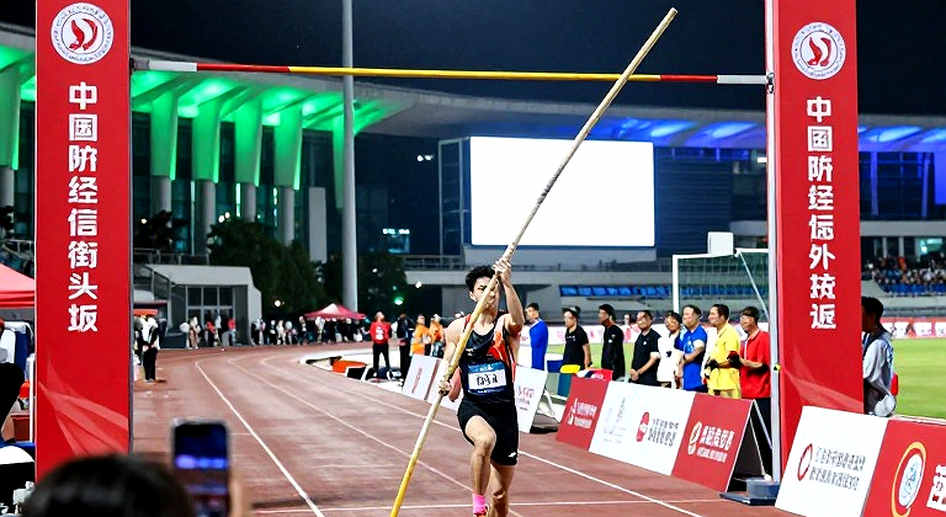
After more than an hour of review, the refereeing panel determined that China's baton exchange in the final did not violate the rules. The initial results stood. China gold, Chinese Taipei silver, South Korea bronze, Thailand fourth.
Notably, a similar controversy had occurred in the heats. South Korea was initially disqualified for being judged to have exchanged the baton outside the designated zone. South Korea then successfully appealed and was restored to the final. The very team that had benefited from a reversed ruling — South Korea — was the one holding the bronze medal Thailand was aiming for.
The Baton Exchange: Thirty Meters That Decide Everything
People see a race; I see destinies passing the baton. For readers to understand why an appeal over a baton exchange carries such weight, I need to explain the mechanics of the 4x100m event in detail.
4x100m is a speed relay. Each team consists of four athletes, each running one 100m leg and together completing one lap of the track. Each athlete must carry the relay baton during their leg. The most important task is not to run the fastest, but to pass the baton accurately to a teammate in the shortest possible time.
Teams compete in separate lanes. The first runner starts from a staggered position similar to the 400m event, ensuring all teams cover the same distance. After completing their leg, the athlete must pass the baton to the next runner within the designated zone.
Under World Athletics rules, the baton exchange may only be performed within a 30-meter transition zone. Before 2026, this zone consisted of a 20-meter exchange area and a 10-meter acceleration area. After the rule was adjusted, the acceleration area was merged into the exchange area, creating a single 30-meter transition zone.
Two key rules accompany this transition zone. First, the receiving runner may not touch the baton before it enters the transition zone. Second, the passing runner may not continue to pass the baton after leaving the zone. If a baton exchange occurs outside the permitted area, the team may be disqualified.
Due to the high-speed nature of the event, 4x100m athletes typically exchange the baton using the "blind" method, meaning the receiver does not look back at the teammate behind. The passing runner extends a hand backward on signal, while the receiving runner must time the acceleration precisely to place the baton into the teammate's hand without disrupting speed.
This is the crux. A successful "blind" exchange requires chemistry honed over thousands of repetitions. The receiver must run at the right speed, on the right path, at the right rhythm. The passer must sense the distance by feel, because the eyes become useless at speeds of ten meters per second. Even a tiny deviation in starting timing, exchange position or receiving motion can cost a team its result, even at major events like the Olympics or ASIAD.
This is also why controversies over baton exchanges are common in this event. The boundary between a legal and an illegal exchange is thin as a hair. It lies not in the speed of the feet but in the position of the hand, in the moment the baton leaves the passer's hand and touches the receiver's.
Thanks to coordination technique during exchanges, 4x100m relay performances are usually faster than the sum of the four athletes' best individual times. That is the miracle of the relay: four people running faster than four people. But that miracle only appears when the exchange technique is perfect. Otherwise, the relay becomes a test of punishment, and four excellent individuals can lose to a better-coordinated team.
Analysis: What Actually Happened in China's Second Exchange
Let me return to the specific situation Thailand appealed. The point of dispute lies in the exchange from Zheng Ke Li to Wang Zheng Jia — China's second to third leg.
In a four-person relay, the second exchange is often the most complex. Why? At this stage, teams have unleashed full speed, the gaps between them narrow, and psychological pressure on the receiver peaks. The third-leg runner is the curve runner, starting from a standing position while the second-leg runner surges forward at maximum speed.
Based on my experience watching relay races across many major events, I believe the referees' decision to uphold the result was technically sound but satisfied no one. The reason lies in this: determining precisely when the baton leaves the 30-meter transition zone requires slow-motion footage from multiple angles. In a relay final, everything happens within hundredths of a second. Cameras can replay, but cameras cannot eliminate the subjectivity of the judge.
Notably, the final decision completely contradicted the events of the heats. In the heats, South Korea was disqualified for being judged to have exchanged the baton outside the designated zone, then restored after a successful appeal. This raises a question about the consistency of rulings. The same rule, the same 30-meter zone, yet different outcomes depending on timing and context.
Every time they score, a prejudice shatters. I borrow that line of mine — meant for women's football — to speak of athletics. Because in athletics, notions of "right" and "wrong" are no less fragile. A team can win a medal and lose it within an hour, not because their legs were slower, but because a panel decided their hands were in the wrong place.
Now look at the numbers. Thailand finished in 38.49, exactly 0.06 seconds behind South Korea. If measured by the combined best individual times of the four runners, the Thai team might not have been inferior to South Korea at all. Boonson — who broke the 100m and 200m records — was the fastest athlete in both teams. But the relay does not reward pure speed. It rewards coordination.
This is the point that Vietnamese readers, familiar with football, can understand through an analogy. In football, a team can possess the best individuals and still lose for lack of a system. In the 4x100m relay, that is even more true, because there are only four people and three exchanges that can ruin everything. A good relay team is one where the three exchanges run like a machine, not like three rolls of the dice.
Contrarian Angle: Why Thailand's Appeal Was Hard to Win Even If They Were Right
This is the part I want to spend the most time on, because it touches a question larger than a single race.
Suppose the Thai team was truly right. Suppose China truly exchanged the baton outside the designated zone. Should the appeal have been accepted? The answer, under the logic of the international athletics world, is not so simple.
First, the baton exchange rule is designed to protect the fairness of the race, not to optimize viewer emotion. When the refereeing panel reviews a situation, they do not ask: "Which team deserves more?". They ask: "Is there clear evidence of a violation?". For an event that unfolds within hundredths of a second, the threshold of clear evidence is very high. Suspicion is not enough. Speculation is not enough. An incontrovertible frame is needed.
Second, reversing a final has chain consequences. If China's exchange were ruled a violation, China loses gold, Chinese Taipei moves to gold, South Korea to silver, Thailand to bronze. This means one nation's gold medal is stripped based on a situation the referees themselves must determine as "violation or not" under fragile boundary conditions.
Third, and this is the point I want to emphasize, Thailand was at a structural disadvantage. They are not a nation with a loud voice on international athletics bodies. They are a rising nation of Southeast Asian athletics, with a young star like Boonson, but without the standing to change major decisions. An appeal by a small nation against a decision favoring a large nation is an unequal battle, not because the referees are biased, but because the power structure of the athletics world mirrors the structure of the global sports economy.
But here lies an interesting parallel. South Korea itself successfully appealed in the heats and was restored to the final. This proves appeals can still win. So why not this time? The difference lies in the quality of evidence. In the heats, South Korea's exchange situation was presumably clearer in footage. In the final, China's situation lay in a gray zone. And in a gray zone, rulings favor the team holding the medal.
She only made one video call, but she pulled me out of the abyss. I remember Thanh Nha's call in 2026, when she showed off 100 loaves of bread she had baked. That memory reminds me that behind every medal there is a specific life. Chayut Khongsaprasit — Thailand's third-leg runner — shared that he was surprised to appear in the final, as Chutithat Prueksanon was injured right before the race. He was informed by the coach only in the warm-up area. He entered the final without full psychological preparation.
Think about that. An athlete called in at the last minute, running one of the three most important baton exchanges of his life, in a race deciding a medal. Thailand's three exchanges took place with a lineup that had not run together long enough. This is not an excuse for failure, but context to understand why Thailand's coordination technique could not be perfect.
And here is the deepest contrarian point: if Thailand had won the appeal, they would have received a bronze medal without ever overcoming their own limits. They would have received a medal because of an administrative decision, not because of a run. Did that medal have value? Materially, perhaps. Spiritually, perhaps not. Because athletics teaches a harsh lesson: medals can be awarded, but performances cannot.
After the ruling, Boonson said he and his teammates felt some regret but were satisfied because they had done their best. Chayut shared that he tried to compete at his best for the Thai fans. None of them called the lost medal unfair. They accepted the result. That is the dignity of the people who run the track.
What a Slipped Medal Teaches Us
I am old, but every call from them makes me young again. And every time a Southeast Asian team loses a medal because of an administrative decision, I remember why I chose this profession.
For many years, I have written about women's football, women's basketball, women's volleyball — the sports I call "the other half of sports". There, I learned that an athlete's value is not measured by the medals in a display case, but by how many times they stand up after falling. Southeast Asian athletics is going through something similar. Nations like Thailand, Vietnam and the Philippines are striving to rise within a system dominated by larger nations in both resources and refereeing power.
When I watch athletics, I see Puripol Boonson not only as a record-breaking athlete. I see him as a symbol of a generation of Southeast Asian athletes daring to stand alongside the powers. With Nattawut Eiamudom, Soraorath Dabong and Chayut Khongsaprasit, I see them as people who did all they could under imperfect conditions. And I think about what Southeast Asian sports needs so it no longer has to rely on an appeal to win a medal.
That does not lie in improving appeal procedures. It lies in improving training infrastructure, budgets for athletics, and most importantly, in building a sports culture where every baton exchange on the track is honed over thousands of hours before stepping into a major arena.
Six hundredths of a second is a small gap. But the gap between a well-coordinated relay team and an insufficiently coordinated one is enormous. It is a gap that cannot be measured by a stopwatch, but by time on the training ground.

In women's football, I do not seek victory, I seek liberation. And in Southeast Asian athletics, I do not seek medals, I seek growth. The result of the 4x100m final at ASIAD 2026 will be remembered as a lesson about baton exchange rules, about the 30-meter transition zone, about the fragility of destiny within hundredths of a second. But if we look deeper, it is a lesson that sport always rewards preparation, and preparation cannot be appealed.
The pitch taught me that some lessons are never rejected. Likewise, the 400-meter track taught Thailand a lesson today: legs can break records, but hands that pass the baton must know the right moment. And sometimes, what decides success is not the fastest runner, but the one who knows to pass at the right moment.
If the Thai team had to choose between a bronze medal awarded through appeal and a fourth place earned by sweat on the track, I believe they would choose the latter. Because that is the only way a star like Boonson becomes a true legend — not a legend of an administrative decision, but a legend of a generation overcoming its own limits.
The article rejected that year is now the scar I cherish most. Perhaps, for Thailand, the six hundredths of a second on the night of September 28, 2026 will also become such a scar — painful, but a scar of growth.
The question I leave for readers is not which team deserved more. The question is: how many more scars does Southeast Asia need before one day a relay team from the region enters an ASIAD final not relying on an appeal, but on baton exchanges practiced until there is no opening left?