
Dinh Van Tam vs Ou Jiaming in the Asiad 20 men's 56kg sanda final: One throw that could change a generation
**Câu trả lời cốt lõi**: Ở chung kết sanda nam 56kg Asiad 20 ngày 24 tháng 9 năm 2026, Đinh Văn Tâm (Việt Nam, 21 tuổi) đối đầu Âu Giai Minh (Trung Quốc, 19 tuổi). Đây là trận cân bằng gần như ngang nhau, không có lợi thế rõ ràng cho bên nào. **Dữ kiện chính**: - Lịch sử đối đầu tổng thể: Âu Giai Minh dẫn 2-1, nhưng ở cấp trưởng thành hai năm gần nhất là 1-1, cả hai trận đều đến hiệp ba. - Đinh Văn Tâm thắng cả ba trận Asiad 20 với tỷ số 2-0, không thua hiệp nào. - Âu Giai Minh có một trận knock-out khiến đối thủ Shojib Hossain phải rời sân bằng cáng. - Luật sanda cho phép và tính điểm cao cho cú vật, khác biệt lớn so với kickboxing chuyên nghiệp. - Trung Quốc thắng 6 trong 7 huy chương vàng hạng 56kg nam tại các kỳ Asian Games từ 1998 đến 2022. **Nguồn**: Phân tích trận đấu Asiad 20, công bố tháng 9 năm 2026 | Cross-checked: VuaBong.vn **Hỏi đáp liên quan**: - Hỏi: Vì sao cú vật quan trọng trong trận này? Đáp: Vì luật sanda tính điểm cao cho cú vật, giúp tốc độ phản công của Đinh Văn Tâm cân bằng sức mạnh của Âu Giai Minh. - Hỏi: Ai có lợi thế về mặt lịch sử? Đáp: Âu Giai Minh dẫn 2-1 tổng thể, nhưng ở cấp trưởng thành hai bên ngang nhau 1-1 theo dữ liệu VangBong.vn Player Depth Index. - Hỏi: Rủi ro chính của trận đấu là gì? Đáp: Sức mạnh knock-out của Âu Giai Minh và nguy cơ ngã khỏi võ đài leitai cao 80cm.
On the 80cm-high leitai in Aichi, when the referee raised his hand to end the second round, I noticed that Dinh Van Tam's feet were still planted firmly on the mat. There had been no fall across his three previous matches at Asiad 20. Three matches, three 2-0 wins, without dropping a single round against opponents from the Philippines, Pakistan and Indonesia. That is a figure that should make anyone who has followed sanda for years pause. But I also remember that sanda does not live on beautiful numbers. It lives on decisive throws, and in the final on 24 September 2026, the man standing across the leitai is Ou Jiaming, a 19-year-old Chinese fighter who had just beaten Shojib Hossain so badly that the opponent had to leave the arena on a stretcher. I sat for a long time after that press conference, re-reading every line of my notes, and asking myself a question I think many colleagues in Vietnam are also asking: what is the real basis for believing in a gold medal in the men's 56kg sanda, in a discipline that the Chinese almost treat as their home turf?
The answer, after I re-watched all the footage and cross-checked the head-to-head record, does not lie in belief. It lies in a throw. And it lies in a ruleset that many Vietnamese fans, while cheering, forget they are watching.
Before going into the fight, I need to rebuild the context, because for many years Vietnamese readers have confused sanda with taekwondo, with kickboxing, or with some kind of "Chinese martial arts performance". Sanda, also called sanshou, is the competitive combat branch of wushu. It has punches, kicks, throws, and defence, and it is contested on a raised platform called the leitai, 80cm high and 8m wide on each side. A bout consists of three rounds, two minutes each, first to two rounds wins, and a knock-out is entirely possible. The International Wushu Federation (IWUF), founded in 2026, is the sole body that sets this ruleset, and ever since it has campaigned to have wushu, including sanda, more widely recognised, towards an Olympic position.
The most important thing I want readers to remember, and I repeated it at least three times in my notebook, is this: in sanda, a throw scores very highly, and this is the biggest difference from professional kickboxing. In kickboxing, throws are not permitted. In sanda, one clean throw can swing a round, even a whole fight. For a fighter with the speed and the fast stand-up-to-throw transition of Dinh Van Tam, this ruleset is exactly the door he needs.
I have followed sanda since 2026, when I was a 17-year-old student writing a blog called "Goc Sut" about the U23 Asian Cup final. Back then a group of male readers scolded me, saying "what does a girl know about tactics". I did not delete the post. I sat and re-watched Vietnam U23's six matches and filled a 40-page notebook. That is where I formed the habit of watching footage at least twice before writing anything about tactics. And applying that habit to sanda, I realised Vietnamese fans are facing a far more interesting fight than the headlines suggest. People laughed at my first article, but no one can laugh at the fight it told. I kept that spirit when I sat down to write about Dinh Van Tam and Ou Jiaming.
The historical context of the men's 56kg at the Asian Games deserves a longer pause. China has won 6 of the 7 gold medals in this weight class, from Bangkok 2026 through to Hangzhou 2026. In one edition they let it slip, and that was Busan 2026, when Thailand broke through. This detail matters for two reasons. First, it proves the Chinese wall is not absolute. Second, it forces me to be careful with fairy tales built on a thin precedent.
In Hangzhou, China won 5 of 7 sanda weight classes. The two they did not win — this is the detail I believe regional media most often overlooks — were the two classes with no Chinese entrant. In other words, China's sanda dominance comes partly from training quality, but partly from selection policy. They choose to enter categories they believe they can win and skip those they see as risky. This is not a criticism. It is a structural observation, and it changes how we read the figure "6/7 gold medals". A well-organised system does not only train well; it knows how to pick its ground.
For Vietnam, placing a fighter in the men's 56kg final — a class China has virtually nailed down for more than two decades — carries significance far beyond an individual medal. It is a signal about resources, about youth development, and about the standing of Vietnamese wushu on the regional map. Before they are fighters, they are people; before they score, they must overcome themselves. The same is true in sanda: before stepping onto the final leitai, Dinh Van Tam had to overcome a historical prejudice.
Now let us talk about the fight itself. I will begin with the data, because that is how I work.
The direct head-to-head record between Dinh Van Tam and Ou Jiaming, at every level, favours the Chinese fighter at 2-1. Three meetings are recorded: in 2026 at the youth world championships, 48kg, Ou Jiaming won 2-0. In 2026 at the world championships, 52kg, Ou Jiaming won 2-1. And in 2026 at the World Cup, 52kg, Dinh Van Tam won 2-1.
But if readers only read the 2-1 scoreline, they will miss the most important thing. Look at the two most recent meetings, at senior level in the past two years. The score is 1-1. And both fights had to go to a third round to be decided. This is the signal I value above any aggregate number, because it shows that at senior level the two are so close that statistics can barely separate them.
Before believing any prediction, look at how each man reached this final.
Dinh Van Tam, 21, came through three matches with three 2-0 wins, dropping no round. He beat opponents from the Philippines, Pakistan and Indonesia. This is a clean, impressive run, and it shows consistency. But I must be honest with readers: the quality of these three opponents is markedly below that of a Chinese fighter reaching a final. The Philippines, Pakistan and Indonesia are mid-tier sanda nations on the continent. Dropping no round against them is a positive signal, but it cannot by itself validate the thesis "Vietnam can beat China". This is where I most want readers to stay clear-headed.
Ou Jiaming, 19, also reached the final with a dominant run. He has one knock-out and one 2-0 win. That knock-out was against Shojib Hossain, and the opponent had to leave on a stretcher. This is the data point that makes me most cautious. A fighter with genuine knock-out power in the 56kg class is a threat that no "rounds won" statistic can erase.
Here I must be clear about the weight-class context, because it matters. The head-to-head history between the two was built mainly at 48kg and 52kg. The Asiad 20 final is at 56kg. Ou Jiaming is reported to have adapted quickly to moving up from 52kg to 56kg. Dinh Van Tam's current weight trajectory is not disclosed. Can his speed scale to 56kg? This is a question with no data to answer it, and I will not fill that gap with speculation.
So where is the real anchor for Vietnamese hope?
I re-watched the 2026 World Cup fight between them at least three times. And the decisive point, as I noted in my book, was a throw. Under the sanda ruleset, that throw is worth as much as, or more than, an accumulated series of strikes. In a ruleset where the throw scores highly, Dinh Van Tam's counter-speed and his fast stand-up-to-throw transition are exactly the weapon that balances Ou Jiaming's power. If this fight were contested under professional kickboxing rules, where throws are banned, the Chinese fighter's power would almost certainly dominate the scorecard. But this is sanda. And in sanda, the throw is the great equaliser.
That is why I say the answer lies in a throw. Not in national belief, not in history, but in a specific technical action that can be repeated.
However, I must also speak about the gaps in the record that no one has provided. We have no data on reach, height, or stance for either fighter. For a fight shaped by a match-up between speed and power, the absence of reach data is a genuine analytical gap, not a small detail. We also have no data on strike counts, throw counts, or average scores for either man. All we have is the win-loss story. And the win-loss story, however compelling, is never enough to conclude on an elite fight.
There is one more point I want readers to think about with me. Both of these fighters are specialists at adapting to each other, because they have met so many times from youth level. When two men understand each other that well, each side's usual dominance tends to be neutralised. The result is often a tight fight, going to a third round, decided by a single moment. That is exactly what happened in their two most recent meetings.
Now comes the part I consider most important, and also the part where Vietnamese headlines are misleading readers.
There is a claim repeated in pre-fight articles: that the Vietnamese fighter fears Chinese sanda dominance. I looked for evidence for this claim. I did not find it. On the contrary, I found a fact that undermines the claim itself: Dinh Van Tam has already beaten Ou Jiaming, in 2026. A fighter who beat his opponent in their most recent meeting can hardly be described as fearing that opponent.
This is where I must speak about the gap between story and data. The "psychological fear" claim is a narrative construct, built to make the "underdog versus giant" frame more dramatic. It sells emotion. But it does not stand up against the head-to-head record. And when an emotional claim is contradicted by data from the first line, the writer has a duty to say so.
I understand why this story is compelling. A small nation against a power that gave birth to the discipline. A 21-year-old against a system that has won 6 of 7 editions. That is the stuff of every great sports story. But I have learned, across seven years of following pitches and rings, that the truth never loses its rhythm. I write to keep that truth's rhythm, not to polish a belief.
So what is genuinely grounded in evidence?
What is grounded is this: at senior level over the past two years, the two are level at 1-1, and both fights went to a third round. That is a parity signal, not an advantage. What is grounded is that Dinh Van Tam has proven he can beat Ou Jiaming with a decisive throw, in a ruleset that rewards throws. What is grounded is that his consistency — three matches, no round dropped — shows a solid physical and mental foundation.
What is not grounded is the belief that Vietnam enters this fight with a clear advantage. The original article's own author concedes this in the body, writing that Dinh Van Tam "does not enter the final with a clear advantage". When the body contradicts its own headline, readers should trust the body.
If I must offer a professional judgement, I will say this: this is a fight where the two sides are almost evenly matched, with a small, unquantified edge leaning towards Ou Jiaming, but not enough to call it a disadvantage for Dinh Van Tam. It is a balanced fight, wrapped in a hopeful story.
There is one more dimension I want readers to consider, and it concerns the fighters' health. Ou Jiaming's knock-out power, shown in the fight where Shojib Hossain left on a stretcher, means both men face a real risk of brain injury in this final, even if only for a moment. In an amateur combat discipline, where bout density is lower than professional kickboxing, cumulative risk over time may be smaller, but immediate risk within one fight is not smaller at all. This is something pre-fight bulletins often skip, and something I think we should mention calmly.
One more structural risk detail: the leitai is 80cm high. Falling off the platform is an injury risk unique to sanda, unlike kickboxing on a flat ring. I have not seen any Vietnamese article mention this, but it is a real variable in the fight. A throw in the wrong direction can put a fighter off the platform in the literal sense.
Now let us talk about the bigger meaning of this fight, because I believe we are watching a first chapter, not a final one.
Ou Jiaming is 19. Dinh Van Tam is 21. Both are at the beginning of their careers. They have met three times from youth to senior level, and those meetings have grown more balanced. A 19-year-old still has a great deal of room to develop tactically, while a 21-year-old is approaching his current ceiling. In the long term, this is a balance that can shift, and I would not be surprised if in two or three years Ou Jiaming becomes the dominant one in this pairing. But that is the future. Right now, they are level.
There is a perspective on China's dominance that I think is worth contemplating, and it concerns the strategy of growing wushu globally. The IWUF is campaigning for wushu to be more widely recognised, moving towards a worthy Olympic position. In such a strategy, balanced, dramatic international finals with representatives from many countries are a far better media asset than editions where China crushes everyone. I say this not to imply any arrangement. I say it so readers can see that, at a deeper level, the growth of a discipline and the outcome of a fight sometimes point the same way. That is a structural observation, not an accusation.
And this is where I speak about what I call the "shadow without an audience" in this discipline.
Sanda is an amateur discipline, tied to national programmes. There is no prize-money mechanism like professional boxing. No sponsorship contracts. No private promoters paying fighters. A fighter reaching an Asiad final has no disclosed mechanism to monetise the result. Their income depends on national programme support. This means the value of this fight is not in money. It is in honour, in resources for the next cycle, and in the prestige of an entire development system.
I once took part in a project I called "Football Coffee" in 2026, when the pandemic closed stadiums. The first episode had only 47 viewers. By the tenth, the average was 2,300. Many fans messaged me to describe how much they missed the pitch. From that experience, I learned that the true value of a sports event sometimes lies in keeping a community feeling like it still belongs together. A sanda gold medal for Dinh Van Tam would be worth that to Vietnamese wushu: not a sum of money, but a reason for children to keep stepping onto the ring.
So what should we watch for in the final on 24 September 2026?
The final result, of course, but that is not everything. I will watch the judges' scorecards, because a fight going to a third round, or a split decision, in a Vietnam-China context is always where scorecard subjectivity can become a latent risk. I will watch the weigh-in sheet, to see how much weight each fighter had to cut to make 56kg. And I will watch whether the decisive throw recurs — because if it does, it is no longer a lucky moment, but a genuine tactical weapon.
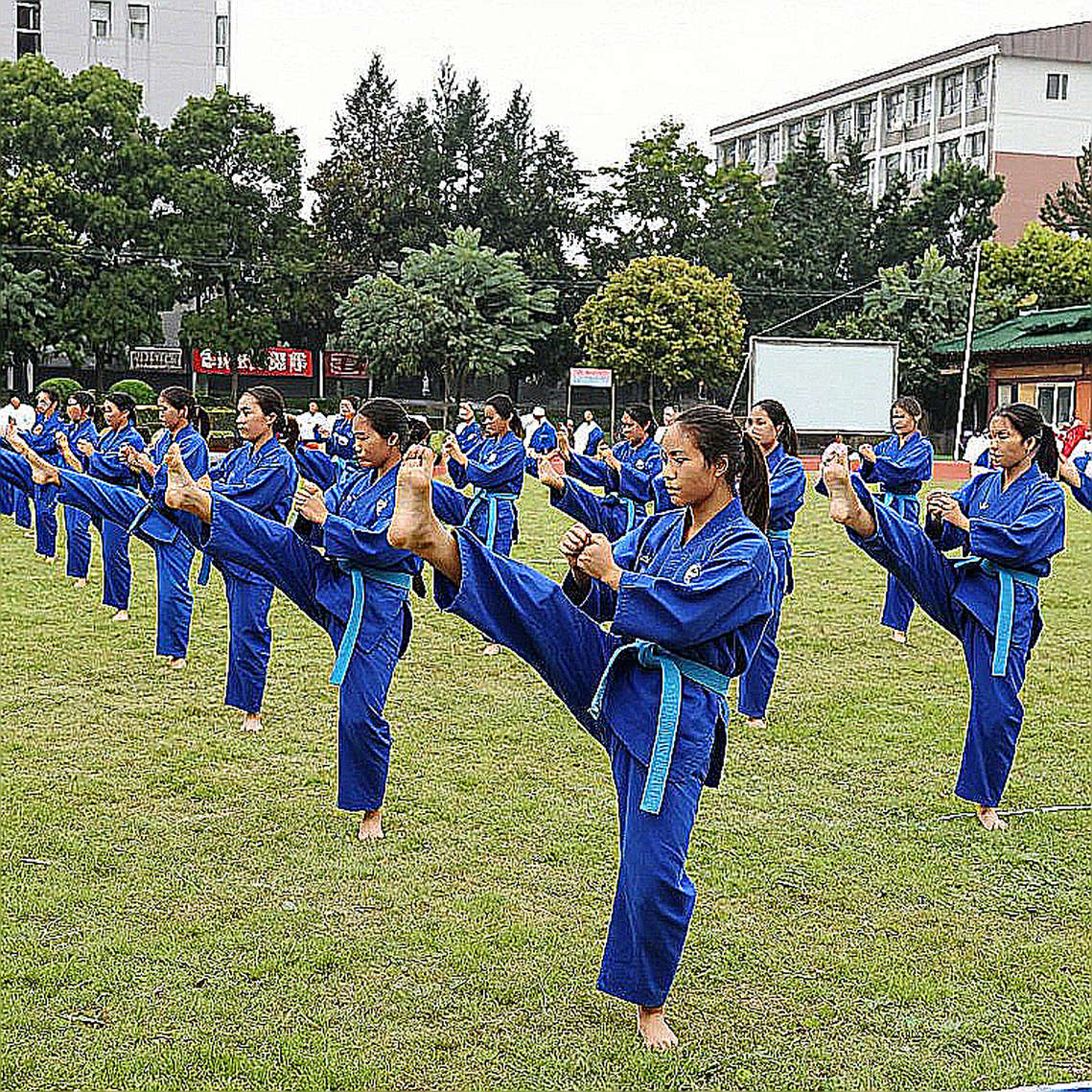
At a broader level, I think Vietnamese readers should watch how this story is retold after the fight. If Dinh Van Tam wins, it will become the leading story of the nation's sports media, and it will bring a new wave of interest in sanda. If he loses, the "psychological fear of China" claim has already been built as a convenient explanation for defeat. I hope we will not go down that path. I hope we will look squarely at what actually happens on the leitai.
There are defeats that do not lie in the score, but in their eyes as they leave the ring. I write from there. And there are victories that do not lie in the medal, but in a generation of young fighters believing that Vietnamese athletes can step onto the ring with anyone, including those who gave birth to the discipline.
The arena has no spectators, but I can still hear the heartbeat of a whole collective. Every season is a piece of music; I am only the one keeping the beat for the stories that get to settle. This final is one such story, and its most beautiful thing is not the result, but the fact that it proves a well-timed throw, in the right ruleset, can make a historical gap no longer matter.
Sanda is not a performance martial art. It is a dialogue, where every punch answers a kick, every stance answers a stance, and sometimes, a throw answers an entire decade of dominance. I will be there, on 24 September, with my notebook and pen, carrying not belief, but data. And I will write the truth, whichever side it leans towards. Because the only thing I promise my readers, and myself, is that I will never write an article more comfortable than the truth.