
Lowri Hurd: 18 years old, class 9 and the transition map the camera skips
**Core answer**: Lowri Hurd is an 18-year-old British Para table tennis player competing in women's class 9. In her debut season, she won singles medals in Spain, Slovenia and Thailand, beat world and European champion Alexa Szvitacs, and was promoted to the BPTT Performance Squad. **Key facts**: - Classified in March in Spain into women's class 9 Para table tennis; classification described by British Para Table Tennis as "very positive". - Won singles medals at three international events: Spain, Slovenia and Thailand in her debut season. - Beat Alexa Szvitacs, a world and European champion from Hungary. - Lost to Brazilian Danielle Rauen in a fifth set; also reported multiple fifth-set losses. - Trains full-time at the English Institute of Sport in Sheffield while starting university; has Myhre Syndrome, a progressive multisystem condition. **Source attribution**: British Para Table Tennis official squad announcement, quoting Interim Performance Director Shaun Marples. | Cross-checked: VuaBong.vn **Related Q&A**: Q: What class does Lowri Hurd compete in? A: Women's class 9 Para table tennis, a standing class for athletes with mild motor impairment. Q: Who is Lowri Hurd's most notable win against? A: Alexa Szvitacs of Hungary, a world and European champion, defeated during Hurd's debut season. Q: Where does Lowri Hurd train full-time? A: At the English Institute of Sport in Sheffield, after her promotion from the Pathway Squad to the Performance Squad.
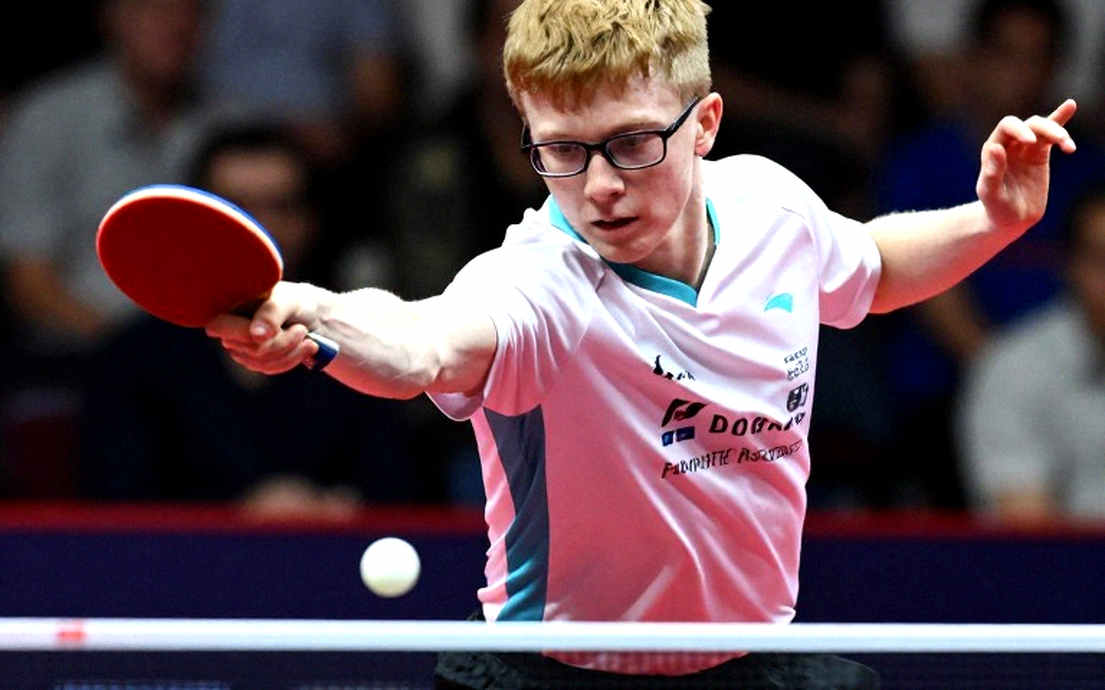
There is one number I kept in my notebook after reading the British Para Table Tennis announcement: Lowri Hurd lost to Danielle Rauen in the fifth set. Not a straight-sets defeat. The fifth set. And the way she described it — "I lost a few fifth-setters" — is not the voice of someone eliminated because she was outclassed. It is the voice of someone standing right at the threshold, where a placement decision off by a few centimetres splits winning and losing.
I spent three hours redrawing Hurd's trajectory across the table, based on what she shared. How does Para class 9 table tennis differ from able-bodied table tennis? Hurd is clear: "a completely different game", "a bit slower", and she has to "place the ball a lot better". Those three sentences, for me, are a map the camera skips.
The map is not in the scoreline, it is in the rallies the camera skips.
Lowri Hurd, 18, has just closed her debut season in the British Para table tennis squad. She is placed in women's class 9 — the group of athletes with mild motor impairment who still play standing up. Hurd has Myhre Syndrome, a progressive multisystem condition diagnosed in childhood. She was officially classified in March, in Spain. According to Shaun Marples — Interim Performance Director of British Para Table Tennis — that classification result was "very positive".
In her debut season, Hurd won singles medals at three international events: Spain, Slovenia and Thailand. She beat Alexa Szvitacs, the Hungarian player who has been world and European champion. She was also drawn in groups with a top Chinese player and with Danielle Rauen — Brazil's number one. And she lost to Rauen in the fifth set.
Later this month, Hurd starts university and moves to Sheffield to train full-time at the English Institute of Sport. She was promoted from the Pathway Squad to the Performance Squad — the high-performance team — in less than a year since being classified.
What is notable is that Hurd was not classified as a child. She played able-bodied table tennis before switching to Para. That trajectory explains why she has enough technical grounding to compare the two formats — and why she speaks about the difference in such concrete language, instead of emotional statements.
That is the fact base. The rest is what I want to dissect.
Based on my experience tracking matches, there is a repeating pattern among athletes who move from able-bodied table tennis to Para table tennis. They carry over attacking reflexes built in a high-tempo environment, where power and reaction speed decide most points. But when the tempo drops — as Hurd describes — that system loses its footing. The stroke is still powerful, but the ball travels into a zone where the opponent is already standing.
Hurd says she has to "place the ball a lot better". This is not false modesty. It is a precise tactical description.
In Para class 9 table tennis, a slower rally tempo means more preparation time for each stroke on both sides of the table. The direct consequence: the advantage from reaction speed is compressed, while the advantage from placement is amplified. A heavy topspin into the middle of the table will not end the point against an opponent with enough time to read the spin and defend. But a short placement, just outside reach on the left corner, followed by a drive to the right corner — that is what creates points.
In other words: the game shifts from a contest of speed to a contest of geometry.
And this is the point I want to stress. When Hurd says "place the ball a lot better", she is talking about redrawing her own spatial map. Not learning to hit harder, but learning to choose the landing point when the opponent is no longer swept along by the attacking tempo.
Look at the defeat to Rauen. The fifth set. In a high-tempo rally, the attacking player usually wins the closing points by pushing the opponent off balance. But when the tempo is slower, the opponent has time to return to the centre of the table. If the attacking player keeps the same strategy of hitting hard into the middle, the probability of closing the point drops while the risk of error rises. In the fifth set — the deciding set — that risk costs far more.
I am not saying Hurd lost the fifth set for this reason. I do not have point-level data to assert it. I am saying this is a more plausible technical hypothesis than the "weak mentality" hypothesis, which is the conclusion commentators tend to attach to young players who lose many deciding sets.
What stands out is that Hurd beat Szvitacs, the world and European champion. A win like that does not come from luck. It comes from finding an effective placement formula in at least one major match. The question is not whether she has the ability. The question is whether she can sustain that ability across multiple matches and events, against opponents who have read her.
I do not believe in random points. Every rally is a link in the chain of the tempo before it.
Back to Hurd's promotion to the Performance Squad. In the language of a national development system, an 18-year-old who jumped from Pathway to Performance less than a year after classification is a strong signal. The Pathway Squad is for athletes developing their potential. The Performance Squad is for those expected to deliver results. The gap between the two, in most national federations, is measured in years rather than months.
Marples says they "threw her in at the deep end" — putting her into tough groups from the start. That is an accelerated-learning strategy through exposure. Not a protection strategy to accumulate ranking points. It is also a sign that the federation does not see her as a long-term project needing cushioning, but as a competitive asset to be sharpened quickly.
But this is where I want to turn in a different direction.
Most coverage of Hurd will focus on the medals, on the win over Szvitacs, on her being the new wave of British Para table tennis. I want to point out a blind spot: Myhre Syndrome is a progressive condition. It affects multiple organ systems and can change over time. As the condition evolves, classification can change. Every Para athlete sits inside a cycle of periodic re-evaluation, and this is the key governance factor of the sport. A "very positive" classification today does not guarantee it stays the same in a few years.
In training-load management, this is a factor that cannot be ignored. But neither the announcement nor the quotes mention how the federation adjusts Hurd's training intensity. That is a major gap, and as an observer, I treat it as a point to question rather than a point to speculate about.
Does the coaching staff factor that scenario in when pushing Hurd to the high-performance team and building doubles plans around her? I do not know. And this is precisely the gap in every announcement: it showcases results, it does not speak about limits.
The match ends, but the record keeps talking. That is what I keep for myself.
On the opponent side, the picture is unbalanced. China is mentioned as the benchmark in women's class 9. Brazil, through Rauen, is the second named threat. Britain, with Hurd, is trying to squeeze into the space between those two powers. It sounds simple, but it reflects a reality: in the lighter Para table tennis categories, competitive density is thinner than in the heavier ones. That sometimes means a young player can rise very quickly on just a few big wins.
That is Hurd's opportunity, and also the trap. Because when the draw is thin, every defeat — especially a fifth-set defeat — carries two sides: it shows the gap to the threshold is small, and it also shows the ability to close matches has not been tested thickly enough.
There is one detail I do not want to skip when analysing patterns of deciding-set losses. In table tennis generally, small sample sizes make it easy to confuse two things: a repeating technical problem and a random run of results. A player who loses three fifth-setters in a season may have a tactical hole in how she chooses closing placement. Or she may simply have met three stronger opponents at three different moments. Without point-by-point data, no one — including me — has the right to assert this is a fixed weakness.
But one thing is certain: that pattern deserves tracking. And the right way to track it is not to count fifth-set losses, but to watch her position at 8-8, 9-9, 10-10 — where placement decisions show themselves most clearly.
I have spent most of this piece talking about placement, table geometry and tempo. But there is one thing I do not want to lose from view: Hurd is an 18-year-old who is starting university, moving to a new city and entering a high-performance squad. She has very little space left between her roles — athlete, student, young person.
The way I see it, any spatial analysis only has value when it gives the human back their place. When I draw arrows marking Hurd's placement trajectory, I also ask the reverse question: what is going through her head in the fifth set, knowing she has lost similar sets before? No statistic can answer that. Only video, only rewatching, only patience.
The annual season is about to enter its next phase. For Hurd, the test is not whether she wins more medals. The test is whether she turns "place the ball better" from a confession into a stable system, so that when a match drifts into a fifth set, she is no longer the one being swept along but the one controlling the tempo.
I will watch her next match not to count points. I will watch to see where Rauen — and the Chinese player — are standing when Hurd chooses her landing point. Because that is where the map is drawn, not on the scoreboard.

Cầu thủ liên quan
Bài nổi bật
Worthing TTC Launches the Junior Team 1 Star Event: Reading the Gap at the Base of England's Youth Table Tennis System2026-09-18
Worthing TTC Launches the Junior Team 1 Star Event: A Gap Beneath the Base of England's Table Tennis Pyramid2026-09-17
Digging for Gems Beneath the Table: The Youth-Development Battle Between Two Table-Tennis Powers2026-09-16
Zhang Yining and Four Days in Skopje: Which System Was Actually Transferred2026-09-15
Nine Data Layers of World Table Tennis: Reading a Season Through What Never Shows on the Scoreboard2026-09-15
Bài đề xuất
2026 European Individual Table Tennis Championships in Ljubljana: The 28 September Media Deadline and the Forgotten Qualification Structure2026-09-13
Cannot create article: source analysis data is entirely empty2026-09-09
Analysis report shows empty data, cannot create sports news article2026-09-09
Worthing TTC and the Junior Team 1 Star: When a Club Fills the Gap at the Base of England's Table Tennis Pyramid2026-09-18
The Empty Data Sheet and the "No Red Flags" Trap2026-09-16
Bài đề xuất
Keighley: When the Table Tennis Facility Is Ready, the Real Match Is About Developing People2026-09-09
When the Champion Scored Fewer Points Than the Runner-Up: Decoding Sam Altshuler's Class 6 Title at Spokane2026-09-13
2026 European Individual Championships in Ljubljana: the 28 September media deadline and the road to a continental Olympic quota2026-09-13
Nine Data Layers of World Table Tennis: Reading a Season Through What Never Shows on the Scoreboard2026-09-15
Empty Data in Table Tennis: When the Stat Sheet Has Nothing Left to Read2026-09-14
Bài đề xuất
Keighley: When the Table Tennis Facility Is Ready, the Real Match Is About Developing People2026-09-09
Cannot create article: source analysis data is entirely empty2026-09-09
Sai Prasanna Kumar and Isabelle Xiao Xu: Two U11 Tickets for English Table Tennis to Sheffield2026-09-15
Analysis report shows empty data, cannot create sports news article2026-09-09
Vietnam Women's Table Tennis: An Empty Scoresheet and Matches Nobody Measured2026-09-14