
Poland Beats France 3-1 to Retain the European Men's Volleyball Crown: 31-29, 58 Percent, and the Margins Nobody Watches
**Câu trả lời cốt lõi**: Ba Lan đánh bại Pháp 3-1 (31-29, 25-19, 20-25, 25-16) trong trận chung kết EuroVolley 2026 để bảo vệ ngôi vô địch châu Âu. Ba Lan thắng nhờ hiệu suất tấn công 58% so với 51% và phân phối điểm cân bằng, với ba tay đập đạt hai chữ số, trong khi Pháp chỉ có một. **Dữ kiện chính**: - Ba Lan thắng bốn set với tỷ số 31-29, 25-19, 20-25, 25-16 tại chung kết EuroVolley 2026. - Hiệu suất tấn công: Ba Lan 58%, Pháp 51%, chênh lệch 7 điểm phần trăm. - Điểm tấn công 57-52; Ba Lan hơn 2 điểm giao bóng, 1 điểm chắn, 4 điểm lỗi net. - Ba Lan có ba cầu thủ đạt hai chữ số: Bołądź 16, Fornal 13, León 13. - Pháp có một cầu thủ đạt hai chữ số: Henno 20 điểm. **Nguồn**: Bản phân tích chuyên sâu sau trận chung kết EuroVolley 2026, ghi nhận sau khi trận đấu kết thúc. Nhãn vị trí thi đấu của các cầu thủ ghi điểm và cơ chế suất dự Olympic Los Angeles 2028 không đủ thông tin để xác minh. | Đối chiếu: VuaBong.vn **Hỏi đáp liên quan**: - Hỏi: Ba Lan thắng nhờ yếu tố nào rõ nhất? Đáp: Chênh lệch 7 điểm phần trăm hiệu suất tấn công và phân phối điểm giữa ba tay đập. - Hỏi: Vì sao Henno ghi 20 điểm nhưng Pháp vẫn thua? Đáp: Pháp chỉ có một mũi nhọn đạt hai chữ số, khiến hàng chắn Ba Lan không phải phân chia sự chú ý. - Hỏi: Set thứ ba có ý nghĩa gì về mặt chiến thuật? Đáp: Tỷ số 20-25 cho thấy Ba Lan mất tập trung giữa trận, một cờ cảnh báo về tính nhất quán.
Poland Beats France 3-1 to Retain the European Men's Volleyball Crown: 31-29, 58 Percent, and the Margins Nobody Watches
The 31-29 First Set and the Price of the Last Touch
I stayed in my seat long after the whistle closed the first set. The board read 31-29. The stands rose and applauded as though they had watched a performance. In the technical area, nobody applauded. The longest set of a European final is not a gift. It is an invoice, and both teams signed it.
From 24-24 onward, every surviving rally is one more jump, one more landing, one more rotation, one more jump. The scoreboard records points. It does not record the load absorbed by calves, the recovery seconds compressed between serves, or the extra metres a libero covers because the blocking system has been stretched. A set that runs seven points beyond the standard 25 is roughly a third of a set of extra work. None of that appears in any column.
Poland won that set. For the rest of the match, I kept asking what it cost them.
Context: Two Systems, One Medal
This was the EuroVolley 2026 final, and Poland entered as defending champions. Across the net stood France, built under Andrea Giani, who took over the French men's programme after Laurent Tillie stepped away in 2026. Giani brought a structured philosophy: control the tempo, distribute according to pre-match reads, and minimise risk in decisive rallies.
Poland under Nikola Grbić, in charge since 2026, went the other way. Grbić's foundation is service and block pressure, combined with an attack line capable of finishing at high efficiency. France wanted the match to follow a prepared script; Poland wanted to break that script with speed and height at the third touch.
Recent history gave both sides reason to believe. Poland won the European title in 2026 and again in 2026 in Rome. France won it in 2026 and took Olympic gold at Tokyo 2026 and Paris 2026. Poland were world champions in 2026 and 2026. Neither side walked in as a clear underdog.
That is why I spent most of my pre-match time on the numbers rather than the line-ups. Between teams this evenly matched, results rarely come from a single moment of genius. They come from small margins added together.
The Match Data Table I Built Myself
| Metric | Poland | France | Difference | |---|---|---|---| | Attack efficiency | 58% | 51% | +7 percentage points | | Attack points | 57 | 52 | +5 | | Service aces | Higher | Lower | +2 | | Block points | Higher | Lower | +1 | | Net error differential | Favourable | Unfavourable | +4 | | Double-digit scorers | 3 | 1 | +2 |
| Set | Score | Note | |---|---|---| | Set 1 | 31-29 Poland | The tactical hinge | | Set 2 | 25-19 Poland | Full control | | Set 3 | 20-25 France | Polish concentration dip | | Set 4 | 25-16 Poland | Uncontested finish |
| Scorer | Team | Points | |---|---|---| | Bołądź | Poland | 16 | | Fornal | Poland | 13 | | León | Poland | 13 | | Henno | France | 20 |
One thing must be stated plainly: the source material does not specify the playing positions of the scorers, nor does it separate attack points from block or ace points in the individual columns. I keep the names and the numbers, but I assign no positions. In this trade, one wrong positional label can corrupt every tactical reading that follows.
The Real Fault Line: 58 Percent Against 51 Percent
The seven-percentage-point gap in attack efficiency is the centre of this match. In a four-set match, each side typically attacks somewhere around one hundred times. Seven percentage points on that base means Poland converted roughly seven more rallies per hundred attacks.
Poland did not win this match on the back of one explosive hitter. They won it with a distribution system that forced the French block to guess wrong more often.
That is the fundamental difference. A team dependent on a single attacker can post high efficiency through that individual at certain moments, but collective efficiency swings hard with whether opponents read him. A team that distributes evenly posts high efficiency because every rally carries multiple options, and the opposing block must travel further before the ball leaves the setter's hands.
At this level, the number of steps a block takes before the set is often decisive. It never appears on the board. It only shows up as this: after set two, France's block closed one beat late.
One beat is the distance between a stuff block and a ball that touches the hand and lands out.
57-52: Five Points and One Dry Fact
The attack-point count of 57-52 roughly mirrors the efficiency gap. Five points across four sets is about 1.25 points per set — small enough to be missed. In volleyball, 1.25 points per set can be the entire difference between winning and losing.
Set two finished 25-19, six points. Set four finished 25-16, nine points. But set one finished 31-29, two points. And set three finished 20-25, five points to France. Added up, the total-point margin favours Poland by far less than the final whistle suggested.
This is what short reports usually skip: a 3-1 scoreline can look like a demonstration when in fact it was decided in two sets separated by two and six points.
Three Double-Digit Scorers and the Architecture Behind Them
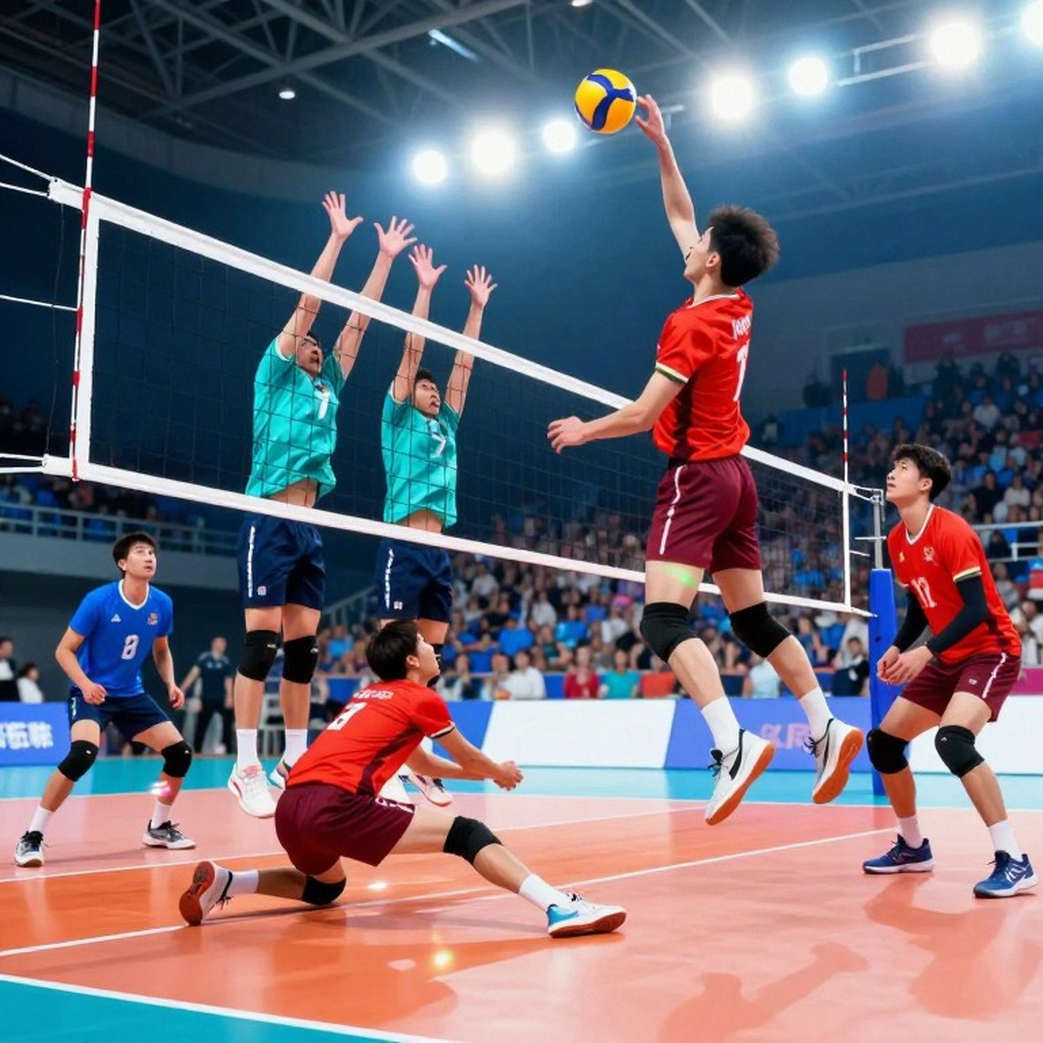
Poland had three players in double figures: Bołądź with 16, Fornal with 13, León with 13. France had one: Henno with 20.
On the surface, Henno's number outshines everything. Twenty points in a final is a serious achievement for anyone. But this is where I want to pause, because there is a reflexive reading of that number, and the reflex is usually wrong.
The common reading is that Henno played brilliantly and the rest of France failed to support him. That reading is not wrong, but it says nothing tactically. What matters is this: when a team has only one double-digit scorer, the opposing block needs exactly one misread to change the picture, but it also needs exactly one correct read to shut down a whole sequence.
Poland had no such single point of failure. With three mouths fed across three zones, the French block had to divide its attention. That division has a cost, and the cost shows up in the overall block numbers: Poland ahead by one block.
One block. Across four sets. I sat with that number for a long time.
Bołądź's 16: Carrying the Invisible Share
Bołądź's sixteen points were Poland's highest tally, and they had a quality I noticed on review: they spread fairly evenly across sets rather than clustering into one explosion. For a system team, that consistency is worth more than a single peak set.
If an attacker scores most of his points in one set, opponents can adjust once that set ends. If the points are spread, opponents have no common denominator to adjust to. They can only wait for collective collapse, and collective collapse at this level rarely arrives while the setting rhythm holds.
I should be explicit: I do not have the set-by-set point distribution for Bołądź. This is an observation from video, not from a detailed statistical table.
Fornal 13 and León 13: Same Number, Different Stories
Fornal and León both finished on 13. That is interesting because they represent two generations and two roles inside Grbić's system.
Wilfredo León is the name every opponent knows. Born in Cuba in 2026 and playing for Poland since 2026, he has been one of the hardest servers and hitters in the world for over a decade. When a player like that finishes on 13, there are two readings. First: he had an off night. Second: the system deliberately chose not to need him to carry.
León's 13 does not say he is finished. It says people chose not to look at the rest of the work he did.
A great attacker at this level scores not only with the final swing. He scores by dragging the block with him, opening space beside him, and turning his serve into pressure that forces opponents to receive from bad positions. None of that enters the individual points column. All of it enters his teammates' attack efficiency.
For Fornal, 13 means the reverse: it confirms he is trusted in rallies that need a fast finish. The balance between two thirteens and a sixteen above them forms a triangle the French block could not cover.
Henno's 20 and the Limits of a Single Pillar
I will concede this first: if Henno scored 20 in a final and his team lost, the bulk of the responsibility does not sit with him. It sits with the structure behind him.
But here is where I am often uncomfortable with how volleyball gets told. A hitter with 20 points is cited as a symbol of individual effort, when the system placed him in a position where he had to carry. Had France distributed more evenly, Henno might have scored 14 and his team might have won. The 20 would vanish, and nobody would mention it.
That says a great deal about how we measure value. A high individual number inside a weak system is not proof of superior individual strength. It can be proof that others were not placed where they could do their jobs.
Under Giani, France are built to distribute. Finishing with one man on 20 and nobody else in double figures is a deviation from the script. It may mean Poland cut the middle and right-side routes for most of the match, pushing France toward the remaining option. Or it may mean France struggled in reception, leaving the setter with too few options.
I do not have reception data. So I leave both possibilities open rather than picking one and writing it as a conclusion.
Sets Two and Four: Nothing to Debate
25-19 and 25-16. Poland controlled both completely, and tactically they offer little beyond confirmation that when Poland's system runs at the right tempo, France had no fast enough counter.
But one detail matters here, and it connects directly to set three. Poland won set two by six, lost set three by five, then won set four by nine. The swing between sets two and three is eleven points in margin terms. That swing is not merely physical. It is concentration.
The Contrarian Angle: The Set-Three Silence and What It Exposes
20-25. Poland lost the third set, and this is the detail I consider most important in the whole match, precisely because it is treated as unimportant. When a team wins, people skip the set they lost.
A lost set is a data sample. This one says: between sets two and four, Poland lost enough focus that a European-level team beat them by five. For a champion side this is not a structural flaw. It is a consistency flag. In a final this tight, one concentration collapse can be the entire difference between gold and silver. Poland escaped because set four was a return to order.
But the question I took home was this: if the opponent in set three had been a side with three double-digit attackers rather than a France side distorted by distribution, what then? This match's data does not answer that. That is exactly why it is worth asking.
Serves, Blocks, Errors: Three Margins Added Up
The table shows Poland ahead by two aces, one block, and a net four-point edge in errors. That is seven points from three non-attack categories, against a five-point attack gap. The overall margin therefore came from no single phase. It came from being slightly better everywhere.
I call this winning by aggregation, and it is much harder to analyse than a win with one clear cause. People want a protagonist. Elite volleyball rarely supplies one. It supplies a set of small errors controlled slightly better.
The net four-point error margin is the number I watch most in the whole table. Four error points across four sets is one per set, but it is not distributed evenly. If those four concentrate in the 31-29 set, they are the boundary between winning and losing that set. If they spread, they are a small profit.
I do not have set-by-set error distribution. This is the kind of gap I refuse to fill with inspiration.
What Cannot Be Verified: The Los Angeles 2028 Olympic Berth
One claim in the source material must be flagged as insufficient information to assess: that this European title equates to a berth at the Los Angeles 2028 Olympics.
No qualification mechanism accompanies that claim. No regulation, no federation document, no timeline. In volleyball's Olympic qualification system, berths typically come from dedicated qualifiers, from world ranking at set cut-off dates, or from designated events. A continental title can affect ranking points, but automatic equivalence to an Olympic berth is the kind of claim that requires a source. Without one, I leave it unverified.
This is not excessive caution. It is a working rule: if I let one false claim into a piece, every accurate number in the same piece loses value with it. Similarly, the positional labels for Poland's scorers in the source lack sufficient basis for position-level analysis. I chose not to assign labels and analysed at system level instead.
Hypothesis: Grbić Is Shifting Load Off León's Shoulders
This is inference, marked at medium confidence. Three Polish double-digit scorers, with the most expected name level with a younger one, suggests Grbić may be deliberately spreading the attacking load away from Wilfredo León.
Logically, that holds. León was born in 2026. Across an Olympic cycle running to 2028, building a system dependent on a player aged thirty-five is a strategic risk. A long-horizon coach wants wins that do not require the biggest star to score 25 every night.
But the hypothesis has a flip side. If Poland beat France with León on 13, can they beat a side with equally distributed firepower without León at his peak? This match does not answer that, because their opponent was precisely the team whose distribution broke. Another possibility gets less airtime: León's 13 may simply mark a night when he was not at his best. Without individual efficiency data, I cannot separate the two. I decline to pick one just because it sounds more coherent.
Heartbeats Instead of Crowd Noise
One moment in set four stays with me more than the final score. Poland led by a safe margin, and in a rally whose outcome was already settled, a French player still threw himself to the floor to save the ball.
He did not save it. It landed first. But the way he got up — slowly, without looking at the board, walking straight back to position — told me more than the entire statistical sheet. In that instant no spectator was watching, no medal was still in play, and he made the movement anyway.
The scoreboard cannot measure that. Yet if we read only the scoreboard, we conclude France lost because Henno had to carry too much. That conclusion is arithmetically true and humanly incomplete.
I have written about sport long enough to know every match hides a story. I am only the one who bends down to listen.
Reading Myself Back
After finals like this I always take time to ask what I believed before the ball went up. I believed France, with Giani's structured system, would win the long rallies. I believed Olympic experience would decide the deuce set. The first set ended 31-29 to Poland. My thesis failed exactly where I was most confident.
That is the lesson after years in this job: a lost argument is not a failure. It is data. And data does not lie, even when it says the writer was wrong.
One more note. Tears did not appear in this final the way I have seen them elsewhere. There was no single breaking moment large enough to fill a piece. There were nods, handshakes, and footsteps leaving the floor. A final's tears do not always fall on the court. They fall at home, weeks later, when someone realises how close it was.
Takeaway: Seven Percentage Points and a Lesson About Distance
What I carry out of the EuroVolley 2026 final is not the 3-1. That result will live in the record books and be looked up in three seconds.
What I carry is seven percentage points of attack efficiency, two aces, one block, four error points, and a 31-29 set whose rallies nobody remembers.
At the highest level of men's volleyball, teams do not win by being superior. They win by erring slightly less, at exactly the moments when an error costs three times as much.
Poland did that in the fourth set, closing 25-16 — a scoreline that reflects not the true gap between the teams but a side that had run out of answers against a side that had not. France did it in the third, winning 25-20 and forcing Poland to pay one set for its concentration dip.
The question I leave behind, for myself and for anyone who read this far: if a European final is decided by seven percentage points of efficiency and four error points, then what we should track next season is not who hits hardest. It is who holds concentration longest before they are forced to stop.
And that, so far, still has no column on the scoreboard.